Another Missive: The Numbers Don’t Add Up
The discrepancy between the numbers used to justify cuts and the actual figures leave me wondering: Where’s the money, DDA?
Dear [Legislator],
I really, really need you to ask this question. I continue to have very serious questions about DDA’s decision-making. And since I am 15 days away from being forced to cut the salary of a valued employee by $5 per hour, I am sincerely hoping you’ll be motivated to press for answers alongside me.
Many legislators projected empathy during two budget hearings and a number of in-person office visits during the 2026 legislative session. At the House Health and Human Services Subcommittee hearing in particular, I thought our community had some allies.
And then efforts to restore funding or any autonomy to participants managing self-directed budgets failed. Many of those same legislators made sad eyes, referenced heavy hearts, and stated that they couldn’t support the restoration of any funds, nor any changes that allowed families more autonomy to manage budgets, because they needed to ensure the future of the waiver programs. And these cuts, they said, were the way forward.
But what if they aren’t?
The main argument used by DDA representatives and apparently swallowed whole by the Governor’s office and the General Assembly centered around cost neutrality. A lot of people’s eyes glaze over when this topic comes up, either because they really hate numbers or because reading federal Medicaid rules is enough to make the eyes glaze over. A few facts to keep in mind:
The deinstitutionalization movement began in the 1950s and gathered steam in the 1970s as advocates pushed for people with disabilities to be cared for in their homes and communities, instead of institutions.Poor conditions and abuse were well-documented by then.
In 1999, the Olmstead decision mandated a shift toward community-based care for those who could live safely in their homes.
Medicaid rules require that per-participant costs of home- and community-based services (ie, Maryland’s Community Pathways Waiver) cannot exceed the per-participant costs of institutional care. DDA insisted that budgets must be contained because Maryland’s home- and community-based services will soon be at risk of exceeding the cost neutrality benchmark.
Exceeding that benchmark puts federal Medicaid funding at risk.
Except that — all terrible math puns intended — the numbers don’t add up.
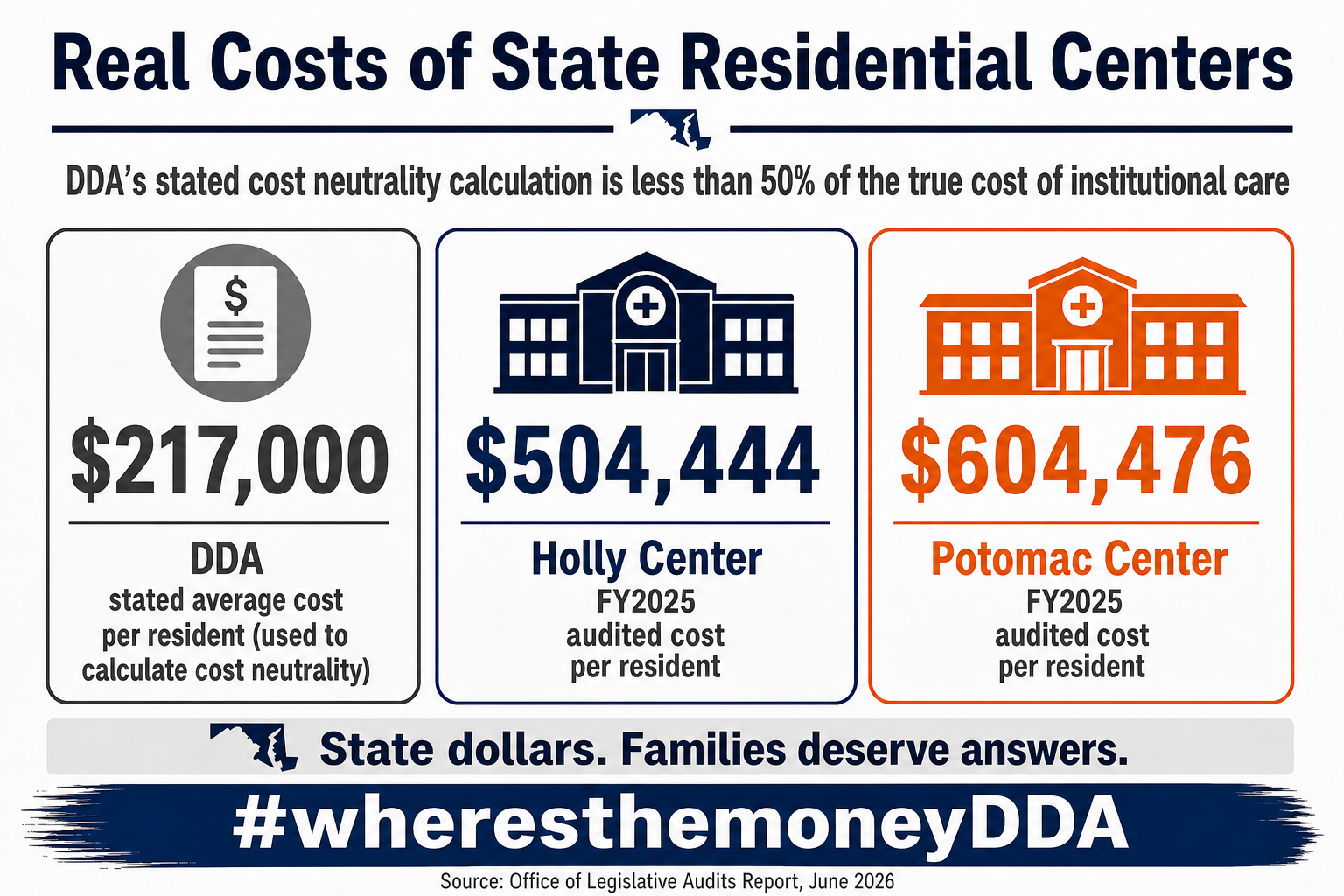
Note that DDA’s stated cost per resident — the all-important cost neutrality benchmark — is less than half of the actual cost of care in Maryland’s two remaining institutions, as published in the 2025 Office of Legislative audits report. They’re shorting their home- and community-based participants.
I have no idea whether Deputy Secretary Hutchinson and her staff can’t read published reports; can’t do basic math; or are deliberately misleading you. Any of the three is concerning. What I need you and your colleagues to do now is to press them for answers, and if you don’t like what you hear, push for changes at DDA. Your most vulnerable constituents need that from you. Ask them where the money is, and where it’s really going.
The General Assembly blew it in April. Try to atone for it now.
[Love, Me]